A Concept for Sustainable Implementation

Introducing AI is not a technical “plug-it-in-and-you’re-done” exercise, but a sustainable process of change.

With a well-thought-out concept, you protect your project from costly bad investments, establish clear responsibilities and ensure that the intended relief reaches day-to-day care practice.

6 Reflection Questions for Developing your Concept

  • Strategy and direction: Where do we currently stand with the digitalization of our facility? What goals are we pursuing with digital solutions?

  • Finances: What costs will arise in the short term and, above all, in the long term (e.g. for licences, maintenance, training, regular updates)?

  • Personnel: Who on the team will take care of the implementation and internal processes? Who will be the permanent point of contact for the team? How much working time do we need to allocate for this?

  • Technology: Is our existing technical infrastructure (facility-wide Wi-Fi, modern end devices) sufficient?

  • Funding: Which points of contact can provide information about funding opportunities and technical requirements?

  • Interfaces: Can the new AI software read data from our existing care documentation system?

Practical tip

Hold a joint meeting with management, IT managers / software providers and nursing management. An internal contact person for finances and funding opportunities should also be part of the discussion.

Together, check whether your facility already has a digitalization strategy or a digital development plan. If not, start with a simple overview:

  • Which digital solutions do we already use?
  • Which challenges would we like to solve through digitalization and AI?
  • What next steps are realistic?

Main topic 1: Financing and Budgeting

Use funding opportunities

There are numerous attractive funding programmes for care at federal and state level. These provide not only information, but also advice and support with the application process.


Total budget, not just the purchase price

Plan ahead. Additional costs often arise for integration into your care documentation system or for external consulting.

An overview of existing funding opportunities

The Competence Centre for Digitalisation and Care provides a regularly updated overview of existing funding opportunities at both federal and state level on its website. This information helps you identify suitable funding programmes and gain an overview of the available options.

Please note that the Kompetenzzentrum Digitalisierung und Pflege does not provide individual funding advice and is not available as a personal point of contact for specific funding enquiries.

Funding and Financing: A Comparison Between Countries

Deutschland Dänemark

Funding programmes for digitalization and AI exist at both federal and state level.

Care facilities and their provider organizations often must identify suitable funding opportunities themselves and apply for funding.

The care landscape is characterized by non-profit welfare organizations and private providers. As a result, financing routes, decision-making structures and responsibilities can differ considerably between facilities.

Due to the different provider and organizational structures, facilities often need to clarify financing, responsibilities and technical requirements more individually.

Financing and funding are more strongly shaped at municipal level. Larger municipalities sometimes have their own innovation funds and can also draw on national support programmes for AI and digitalization. Smaller municipalities sometimes finance such initiatives directly from their care budgets.

Elderly care is predominantly organized by municipalities. Many funding and support programmes are therefore aimed directly at municipalities. Privately operated care facilities are rare and often work on behalf of a municipality. Access to municipal funding opportunities therefore generally takes place through the responsible municipality.

Municipal structures can, in principle, enable joint planning, financing and scaling of digital solutions across several facilities. However, whether this actually leads to easier implementation depends on the individual municipality, its financial and organisational resources, as well as the existing cooperation structures.

Main topic 2: People and Culture

Reducing fears

New technology often causes concerns (“Will AI replace me?”, “What if I do something wrong?”). Address these concerns openly. From the outset, allow sufficient time for clear and understandable training.


Clear responsibilities

Projects fizzle out when no one feels permanently responsible. Clearly defined, named roles are needed (e.g. digitalization officers) so that care staff have someone to contact when questions arise.

Leerer Wohnbereich mit Rollator und Rollstuhl neben einem gedeckten Tisch mit Schachbrett

Main topic 3: Technical Requirements for AI

Low hardware requirements

Most modern AI solutions are cloud-based and run via the internet. You do not need expensive high-performance computers on site.


The minimum infrastructure

A stable, secure Wi-Fi network in all residential areas, modern mobile end devices (tablets/smartphones, e.g. for gait-analysis or wound-analysis apps) and a reliable power supply (e.g. for fall sensors) are essential.


The “interfaces” bottleneck

Many AI tools work best when they can use data from your existing systems (documentation, staff scheduling, etc.) and external sources (pharmacies, hospitals). In practice, however, standardized interfaces are often lacking. AI also requires structured data, whereas care documentation often consists largely of individualized free text.


Data protection (GDPR)

Because highly sensitive health data is involved, IT security must be robust from the very first second. Learn more about this in Step 3.


Symbolgrafik für Datenschutz: Hand auf einer Laptop-Tastatur mit digitalen Schloss- und Sicherheitssymbolen

Main topic 4: Key Success Factors at Organizational Level

Benefit for care practice

AI must make work easier, not harder. If technology supports professional care practice, it will be accepted.


Decision-making authority remains with people

AI is not a replacement for qualified care professionals – it should support decisions.


Clear strategy and prioritization at management level

Without open, committed and innovation-oriented leadership, innovation remains blocked.

Nahaufnahme: Zwei Hände halten behutsam die Hand einer älteren Person im Rollstuhl

Practical example – Digitalization in a country comparison: Denmark and Germany

Deutschland und Dänemark

In a Danish care centre, the structure is clear: if staff are asked who is responsible for introducing a new AI-supported fall-prevention solution, they can immediately give a clear answer and name a designated local contact person.

In a comparable German case, the structure is often more fragmented: responsibility is divided between nursing management, the provider organization’s IT department and senior management.

The result: The software provider does not know whom to contact, decisions are delayed and committed care professionals become frustrated and give up in the face of unclear reporting and decision-making channels. In the worst case, “…something like this naturally fizzles out quickly, and that is extremely frustrating for the employees who want to take responsibility and get involved.” (Interview with an IT expert) 

Practical tip

Before the project starts, appoint a clear, interdisciplinary project team with defined decision-making authority.

Carry out an “infrastructure check” using a simple questionnaire for all areas (care, IT, administration).

Practical example – When wishful thinking meets outdated structures

A nursing service manager wants to introduce AI-supported staff-scheduling software to provide the team with flexible support when staff are absent at short notice.

But the project quickly stalls: decision-making authority lies solely with conservative senior management, which blocks the idea for months.

When management finally agrees, it ties the budget to the unrealistic expectation that the technology will immediately cut costs and replace staff – pushing the actual benefit for care professionals into the background.

The final setback comes at the purchasing stage: the facility’s existing software landscape is a patchwork of different providers for documentation and time recording. These systems block the new AI solution because interfaces are missing or require high additional costs.

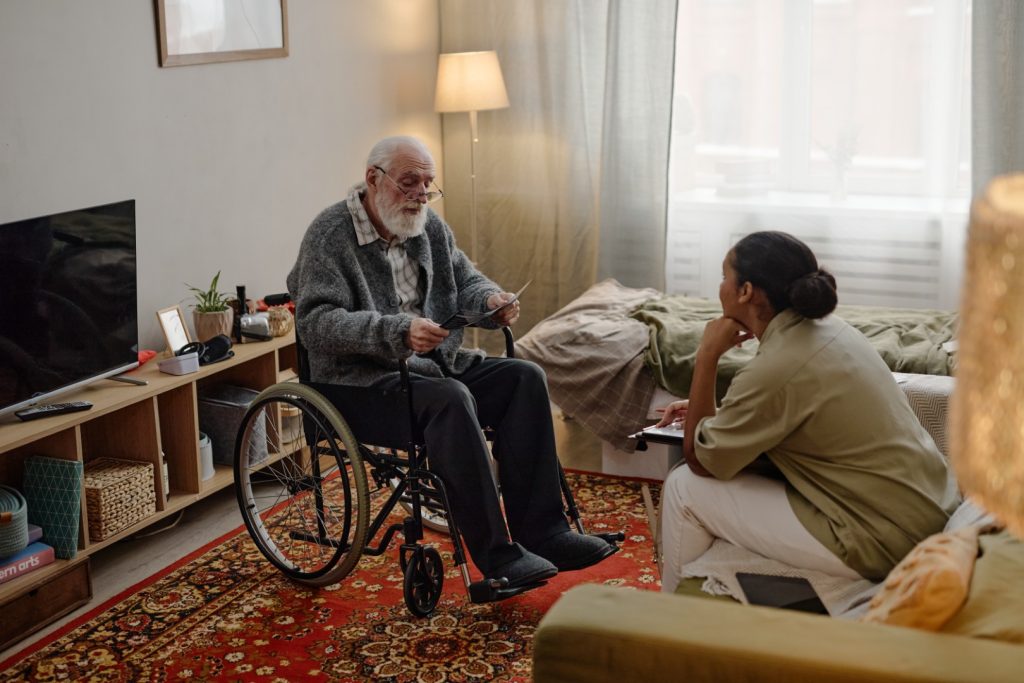
Älterer Mann im Rollstuhl im Gespräch mit einer Pflegekraft mit Klemmbrett in einem Wohnzimmer

Practical tip

Clarify the provider organization’s expectations and the technical openness of your existing software providers in advance to avoid blockages and costly bad investments.

Your result after this step

You now know what the project will cost, who will manage it and whether your technology is ready. You can:

  • Erfüllt:

    realistically assess costs and make use of funding opportunities

  • Erfüllt:

    plan resources (staff, time, infrastructure)

  • Erfüllt:

    assess IT infrastructure and interfaces

  • Erfüllt:

    clarify responsibilities and make processes transparent

What Happens Next

The right AI provider has been selected and the contract is in place? Now comes the step that will determine whether your project succeeds or fails: Step 5: Involving Stakeholders shows you how to bring nursing staff, residents, and families on board from the start and build genuine acceptance for the new solution.

Sources

  • Most of the contents used in the AI Roadmap are based on the project context developed within the “Care-AI” project and the materials collected there.